

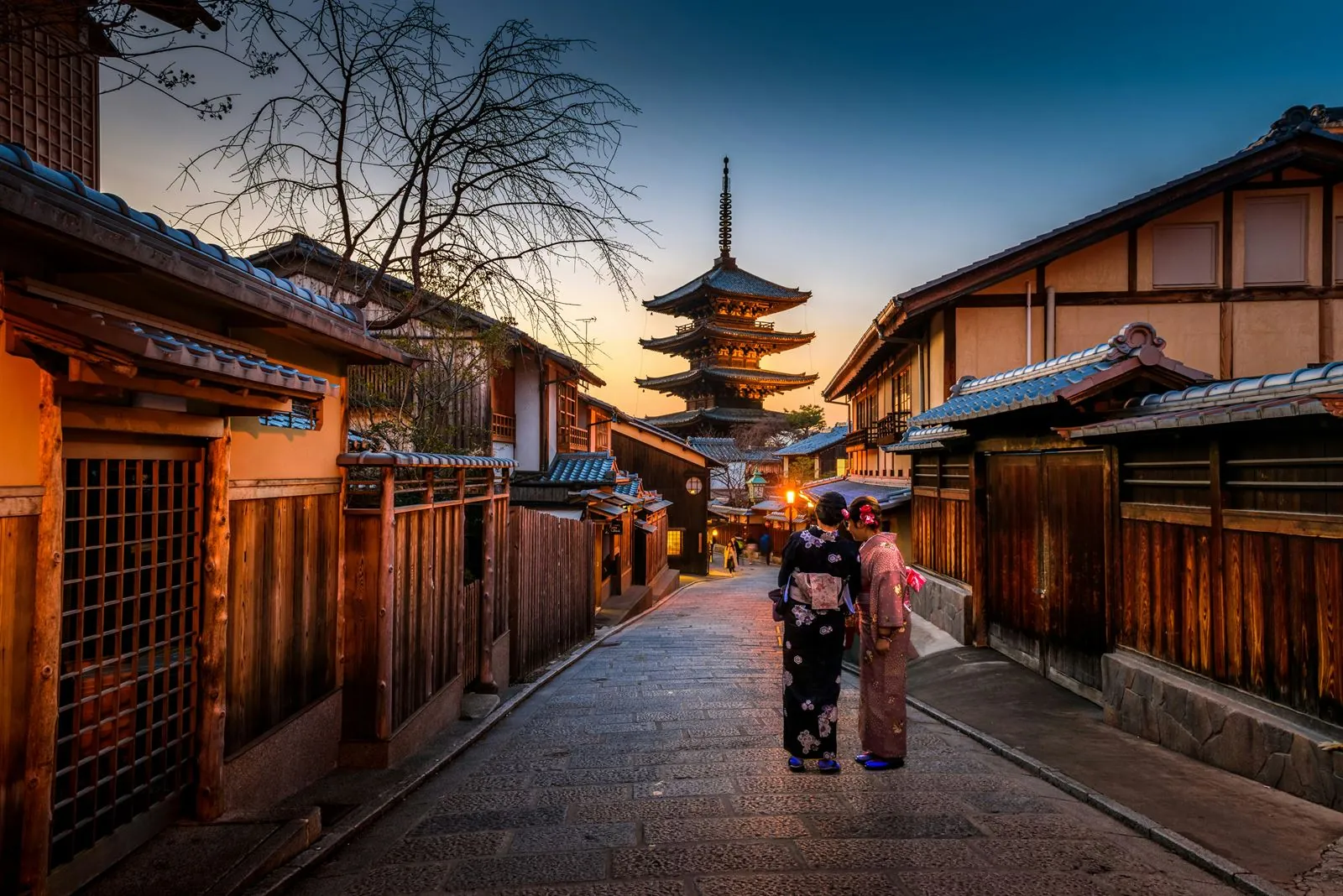
Travelling to Japan respectfully is simpler than it seems: almost all the customs are understood from a single idea, that of not disturbing others. This guide gathers the rules of etiquette and the things worth not doing in Japan — on transport, when eating, with shoes, at temples and baths — so you move around naturally. It is not a frightening list of prohibitions: no one expects a visitor to do everything perfectly, and a small gesture of care is noticed and appreciated.
The underlying idea: do not disturb others
Before memorising loose rules, it helps to understand the thread that links them. In Japan almost all etiquette revolves around one concept: meiwaku, the nuisance or hindrance we cause to those around us. The idea is simple: in a country where many people live and move in very compact spaces — packed trains, narrow streets, small restaurants — coexistence works because everyone tries not to inconvenience others.
From this come the traits that stand out most on arrival: the silence on transport, the order of the queues, the cleanliness of the streets even though there are hardly any bins. They are not imposed rules, but a tacit agreement learned from childhood that sustains collective harmony, the wa. If you understand this, almost everything else follows on its own: when in doubt, ask yourself whether what you are about to do might bother someone.
From that same root come two other traits you will notice straight away. One is punctuality: trains leave at the exact minute and appointments are kept to the letter, so it is worth arriving on time (or a little early) for a reservation or a tour. The other is omotenashi, the attentive, anticipatory hospitality with which a guest or customer is treated; that care for others is the kind face of the same principle of not disturbing, and it is exactly what is appreciated to return with a gesture of respect.
On public transport: silence and order
Transport is where the care not to disturb is most noticeable, and where a visitor can stand out without meaning to. On metros and trains you travel in silence or speaking very quietly: it is common to see packed cars in which almost nothing is heard. So:
- Phone on silent. You set it to "manner mode" (no sound or vibration) and do not talk on the phone inside the car. If a call comes in, the norm is to reject it or get off to answer.
- Conversations in a low voice. You can talk with whoever travels with you, but at a discreet volume. Laughing loudly or playing music without headphones is considered bad manners.
- Give up your seat to the elderly, pregnant women or people with difficulties. Many trains have marked priority seats where, in addition, it is worth turning off your phone completely.
- Queue and let people off first. On the platform there are marks on the floor to wait in line on both sides of the doors; everyone is let off before boarding.
- Backpacks, in front or on the rack. At rush hour you carry the backpack in your hand or against your chest so as not to hit anyone.
The escalator: one side to stand, one to walk
On escalators one side is left free for those in a hurry. And here there is a regional peculiarity that surprises many:
- In Tokyo and almost the whole country you stand still on the left and leave the right free for overtaking.
- In the Kansai region (Osaka, Kyoto, Kobe, Nara) it is the opposite: you stand on the right and leave the left free.
If in doubt, watch what the people in front of you do and copy it. As a note, more and more stations directly ask people not to walk on the escalator and to stand still on both sides for safety, so do not be surprised if you see both. If you are still deciding which cities to include in your route, the guide to the best cities in Japan is a good place to start.
Eating and drinking: chopsticks, tipping and eating in the street
Japanese food has its own etiquette, but most of it is intuitive. Two chopstick customs are worth knowing in advance, because they carry a symbolic weight that is not obvious at first sight: both evoke funeral rites.
- Do not stick chopsticks upright in the rice. It recalls the rice offering placed for the dead, with the chopsticks stuck in, and the incense of funerals. When you are not eating, rest the chopsticks on the chopstick rest or crossed over the edge of the bowl.
- Do not pass food from chopstick to chopstick. That gesture reproduces part of a funeral rite (the kotsuage) in which relatives pass the bones of the deceased after cremation. If you want to share, leave the food on the other person's plate or pass them the dish.
Beyond chopsticks, there are three customs that surprise travellers:
- You do not tip. In Japan no tip is left at restaurants or taxis; good service is taken for granted. Leaving extra money can even cause confusion. You have it detailed in the guide to tipping in Japan.
- Avoid eating while walking in busy areas. Tabearuki (eating while walking) is generally frowned upon; you eat standing, next to the stall or on a bench. The exceptions are festivals, pedestrian stall streets and markets, where it is perfectly normal.
- Slurping ramen is fine. Contrary to what many believe, slurping noodles is not bad manners: it helps cool them and is understood as a sign that they are delicious.
Shoes: when and where to take them off
Taking off your shoes when entering certain spaces is one of the most deeply rooted customs, and it has to do as much with cleanliness as with the separation between outside and inside. You will have to take off your shoes at:
- Private homes and many traditional accommodations.
- Ryokan (traditional inns) and rooms with tatami.
- Some temples, restaurants and shops with a raised wooden or tatami floor.
The clue is the genkan, the entrance hall at a lower level right at the door. There you take off your shoes, leave them (often facing the door) and step up to the interior level. There are usually indoor slippers ready for you.
- On tatami you go in socks or barefoot, never with slippers: they are removed before stepping on the mat.
- The toilet has its own slippers. In homes, ryokan and many public toilets there are slippers exclusively for the bathroom: you put them on entering and — very importantly — take them off on leaving. Walking out and around with the bathroom slippers on is the classic visitor's slip.
Greetings: the bow and using both hands
The greeting par excellence is the bow (ojigi): an inclination of the body used to greet, thank, apologise or say goodbye. The depth varies by situation — a slight bow for an informal greeting, more pronounced to show respect or ask forgiveness — but as a traveller you do not need to master the degrees.
- A slight nod of the head is enough to return a greeting or thank for something. It is a gesture that comes naturally after a few days in the country.
- There is no need to shake hands, although it is increasingly common with foreigners; let the other person set the gesture.
- Cards and objects, with both hands. If you are given a business card (meishi), a leaflet or your change, receive it with both hands and looking at what you are given; it is offered the same way. It is a gesture of respect that is noticed.
If you want to accompany the bow with some words, the Japanese phrases guide has the basics (arigatou gozaimasu, sumimasen), and if you travel to the capital, the language in Tokyo guide helps you get around without knowing Japanese.
Onsen and baths: shower before entering
Thermal baths (onsen) and public ones (sento) have clear etiquette based, again, on respect for others: the bath water is shared and you only enter already clean. The essential rules:
- Shower thoroughly before entering the water, seated on the stools in the shower area. You do not get into the bath to wash, but already rinsed.
- You enter without a swimsuit, completely naked; the baths are separated by sex. The small towel you are given does not go into the water: you leave it on the edge or on your head.
- No splashing, swimming or making noise. The onsen is a place of calm.
You have the full detail — including the tattoo question, which is still restricted at some onsen — in the onsen in Japan guide.
Temples and shrines: basic etiquette
Shinto shrines (jinja) and Buddhist temples (tera) are active places of worship, not just monuments, and they tend to be among the must-see stops on any route (you have them gathered in the what to see in Japan guide). The etiquette is simple and observing others always helps. At a Shinto shrine, the usual ritual is:
- On crossing the torii (the gate), a slight bow. You walk along the sides, not the centre, which is reserved for the deities.
- Purify yourself at the fountain (chozuya or temizuya): with a single ladle of water you rinse the left hand, then the right, then bring a little water to the left hand to rinse your mouth (never drink directly from the ladle), rinse the left hand again and finally tilt the ladle so the water runs down and cleans the handle.
- Before the altar: drop a coin in the offering box, ring the bell if there is one, make two bows, give two claps, form the wish in silence and finish with a final bow ("two bows, two claps, one bow").
At a Buddhist temple you do not clap: you put your hands together in silence to pray. In both places it is best to speak quietly, not smoke and respect the areas where you cannot pass.
Do
- Purify yourself at the fountain before approaching the altar.
- Walk along the sides of the torii.
- Speak quietly and move calmly.
- Check whether photos are allowed before shooting.
Do not
- Walk through the centre of the torii.
- Touch ritual objects or statues.
- Take photos where signs forbid it (often indoors).
- Step with footwear into areas that ask you to remove shoes.
Photos: ask permission and respect people
Japan is one of the most photogenic countries in the world, but the camera also has its etiquette. The general rule is not to photograph people without their permission, and to pay attention to the signs, which abound at temples, shops and restaurants.
- Ask permission before photographing someone up close, especially if they work facing the public.
- Geishas and maiko are not an attraction. In the Gion district of Kyoto, chasing or photographing them without permission is frowned upon and, on some private streets, directly forbidden and fined. They are people going to work.
- Respect the "no photos" signs, frequent inside temples, museums and shops.
You have the context and the specific rules of the area in the guide to the geishas in Gion.
In the street: rubbish, smoking and other details
It is striking how clean the streets are despite there being hardly any bins. The reason is precisely that agreement not to disturb: everyone takes care of their own rubbish.
- Take your rubbish with you. As there are hardly any bins in the street, the norm is to keep your waste in a small bag and throw it away at the hotel, at a station or next to the vending machines (where there is usually a container for cans and bottles). When bins do appear, note that they are usually separated by type: combustibles, cans, plastic bottles (PET).
- Smoke only in designated areas. Many cities forbid smoking while walking in the street; there are marked smoking areas near stations and buildings. Outside them, avoid it.
- Do not blow your nose loudly in public. It is considered unpleasant; if you need to, do it discreetly or in a toilet. A little sniff is tolerated more than a loud blow.
- Respect queues and order. People line up for almost everything (taxis, shops, platforms) and scrupulously respect their turn.
- Pointing at people is avoided; to indicate something you use an open hand.
If you travel as a family, the Japan with children guide covers how to adapt these customs with little ones (transport, meals, breaks).
In summary: effort counts more than perfection
If you take away a single idea, let it be this: in Japan the gesture of someone who tries to do things well is greatly valued, even if they get it wrong. No one will reproach you for a good-faith mistake; on the contrary, the care not to disturb is perceived and returned with kindness.
- Observe and copy. When in doubt, watch what the people around you do. It is the best guide, and it never fails.
- Lower your volume. Speaking more quietly than you would at home puts you in tune straight away, especially on transport.
- Take your time. Taking off your shoes, queuing or purifying yourself at a shrine are rituals you enjoy if you are not in a hurry.
With these customs clear, you will arrive with a solid base to enjoy the trip without stress. If it is your first time, the guide to travelling to Japan for the first time gathers everything else worth having ready before leaving, from transport to money or internet.


