

Not sure which month to pick?
Answer four questions in our tool and we recommend the best month for your trip with real data on weather, prices and seasons — with the scoring in plain sight.
Find my best timeThere is no perfect date to travel to Japan — there is one that is perfect for you. The sakura spring is spectacular but expensive. Winter is cheap and quiet. This guide helps you decide based on your budget, tolerance for heat and appetite for crowds.
The four seasons of Japan
Japan has four very distinct seasons, each with its own character, price and appeal. Unlike many destinations where "low season" simply means fewer tourists, in Japan each season offers a radically different experience. The country literally changes colour four times a year: white with snow in winter, pink with sakura in spring, deep green in summer and red and orange with koyo in autumn.
This variation makes the choice of dates especially important. It is not just about price: it is about what kind of trip you want to experience. The same temple in Kyoto can be deserted in February or completely overwhelmed in April during the peak of the sakura.
Month-by-month comparison: weather, price and tourism
| Month | Avg. temp. | Weather | Tourism | Price | Highlight |
|---|---|---|---|---|---|
| January Winter | 3–10 °C | Cold and sunny | Very low | Lowest | The cheapest month. Deserted temples. |
| February Winter | 3–12 °C | Cold and sunny | Very low | Lowest | Ume (plum) blossoms. No tourists. |
| March Spring | 7–17 °C | Mild, variable | High | High | First sakura in the south of the country. |
| April Spring | 12–22 °C | Mild and sunny | Very high | Peak | Peak sakura in Tokyo and Kyoto. |
| May Spring | 15–26 °C | Pleasant | Medium-high | Medium-high | Post-sakura. Golden Week to avoid. |
| June Summer | 18–28 °C | Rainy (tsuyu) | Low | Low | The cheapest month of the year. |
| July Summer | 23–33 °C | Hot and humid | Medium | Medium | Gion Matsuri and summer festivals. |
| August Summer | 24–34 °C | Very hot | Medium | Medium | Fireworks. Obon (13–16 Aug). |
| September Autumn | 18–28 °C | Heat easing | Low-medium | Low | Transition. Low post-summer prices. |
| October Autumn | 13–23 °C | Mild and dry | Medium | Medium | The best balance of the year. |
| November Autumn | 8–19 °C | Cool and sunny | High | High | Koyo (red leaves). Second high season. |
| December Winter | 5–14 °C | Cold and clear | Medium-low | Medium | Christmas illuminations. New Year. |
Spring in Japan (March – May)
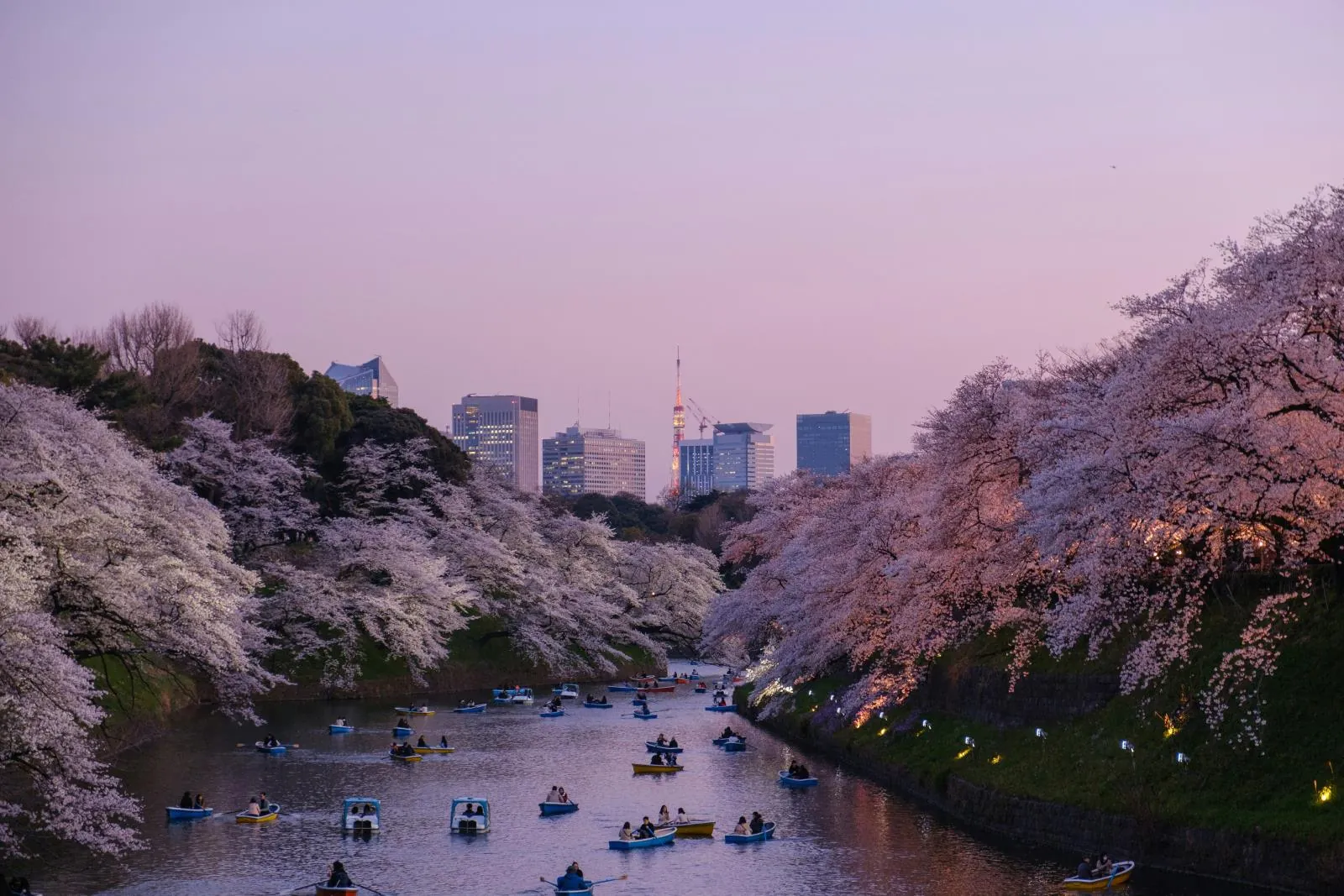
Spring is the most sought-after and most expensive season: mild weather, long days and the sakura, which in Tokyo and Kyoto usually blooms between late March and mid-April. Golden Week also arrives at the end of April. When to book, how much prices rise and who it is for, in Japan in spring.
Summer in Japan (June – August)
The Japanese summer is hot and humid: July and August can exceed 35 °C in Tokyo and Osaka. In return, June, in the middle of the rainy season, is one of the cheapest months of the year, July brings the great festivals and Hokkaido stays cool. Month by month, and what to bear in mind about Obon, in Japan in summer.
Autumn in Japan (September – November)
For many experienced travellers, autumn is the best season: the heat fades and the air is dry. October is the month with the best balance of weather, price and crowds, and in November the koyo arrives, the second high season of the year. Month by month, in Japan in autumn.
Winter in Japan (December – February)
The Japanese winter is cold but dry and sunny: in Tokyo or Osaka it rarely drops below 0 °C. There are few tourists, January and February have the lowest prices of the year and it is the season of onsen in the snow and skiing in Hokkaido. What to expect month by month and at New Year, in Japan in winter.
Typhoon season: what you should know
It is the climate factor most often overlooked when choosing dates and yet it can shape a trip. The typhoon season (taifu) in Japan runs roughly from August to October, peaking in September. It does not mean there will be a typhoon during your trip — many pass out to sea — but it is worth understanding the risk.
How it affects a trip
- Flights: a typhoon on a direct track can cause cancellations of international and domestic flights for a day or two. Airlines usually allow free changes when there is an official warning.
- Trains: JR and the private lines suspend service preventively if strong winds are forecast, including the Shinkansen on the affected sections. Service is restored quickly once the front passes.
- Most exposed areas: Okinawa and Kyushu (south-west) get more typhoons than Tokyo, and the north (Tohoku, Hokkaido) is the least affected.
How to reduce the impact
- Take out travel insurance that covers weather cancellations and delays.
- Leave a margin between the last day of domestic travel and the return flight, to absorb a possible day of disruption.
- Check the Japan Meteorological Agency (JMA) during the trip: typhoons are announced several days in advance.
- If a typhoon is approaching, plan an indoor day (museums, department stores, food) instead of outdoor trips.
In practice, September and early October remain attractive months for their good prices; you just need to travel with some flexibility and the weather information to hand.
Periods worth avoiding in Japan
Japan has several periods of high domestic pressure when the Japanese themselves travel en masse. During these days, trains, hotels and attractions are at their limit. If you coincide with them without having planned for it, the trip can become stressful and expensive.
Golden Week (late April – early May)
From 29 April to 5 May Japan strings together several national holidays: it is the period with the most domestic travel of the year, with full trains and pricier hotels. How it affects your trip and how far ahead to book, in Japan in spring.
Obon (mid-August)
From 13 to 16 August many Japanese return to their home towns for Obon: shinkansen and hotels on the coast and in the countryside fill up, while cities like Tokyo become somewhat quieter. We cover it in Japan in summer.
New Year (31 December – 3 January)
Many shops, restaurants and attractions close between 31 December and 3 January (the most widespread closure is on the 1st to 3rd). 1 January is one of the busiest days of the year at temples (hatsumode). The shinkansen and domestic flights fill up. If you travel on these dates, you will see a different Japan but you will have to adjust your expectations.
When to go to Japan according to your traveller profile
- If you want the sakura: book 4–5 months ahead for March or April. Accept paying more for flights and hotels.
- If you are looking to save: January or February are the cheapest months of the year. Dry cold, very little tourism.
- If you want balance: October is the perfect month — mild weather, koyo at the end, intermediate prices and fewer crowds than in spring.
- If you cannot stand the heat: avoid July and August. Temperatures in Tokyo and Osaka exceed 35 °C with high humidity.
- If you want to ski: Hokkaido in January or February. Low price, abundant snow, and you can combine it with Tokyo.
- If you travel with family: October or November, when the weather is stable and children cope better with the walking.